Fear and the False Binary


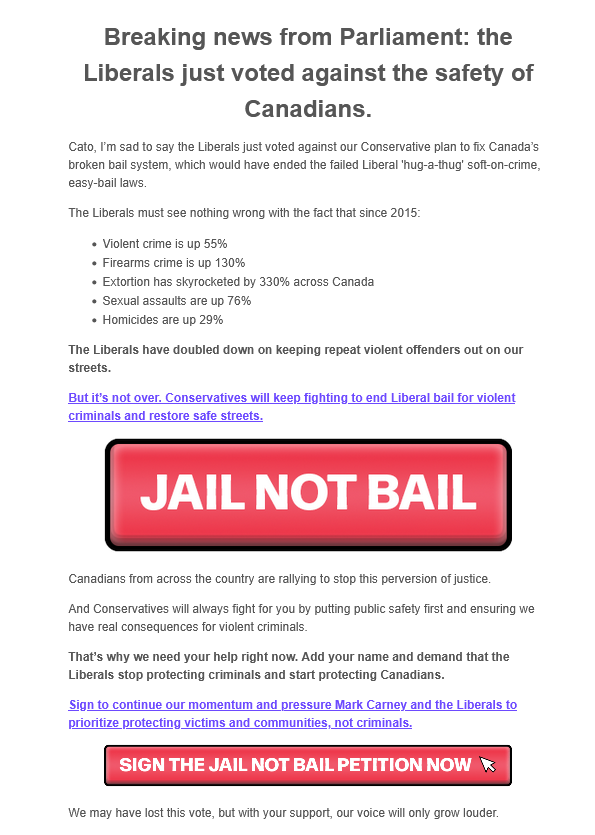
The Conservative Party of Canada’s Jail, not bail bill (C-242) failed to be passed by Parliament on October 6th. As everyone knew it would. It had no support from the Liberals or any other party. My conservative alter ego got a fundraising email immediately afterwards, on the 6th, informing me that the Liberals voted against the safety of Canadians. To a certain extent, this email is a retread of one I got in September, it states some different, mildly misleading statistics and directly connects past Liberal bail reforms to the increase in violent crime without any evidence beyond inference. I had initially thought I’d pass on this one because it is so similar to the last email I discussed, but there are a few phrases I want to drill down on and share some interesting information I found about Canada’s bail system with you. So buckle up while I do some basic textual analysis at you.
Thugs vs Real Canadians
“I’m sad to say the Liberals just voted against our Conservative plan to fix Canada’s broken bail system, which would have ended the failed Liberal 'hug-a-thug' soft-on-crime, easy-bail laws.”
The first phrase I’m latching onto here is “hug-a-thug.” If you enter that phrase into your preferred search engine, the first result is likely to be a Texas non-profit organization that focuses on at-risk youth. However, most of what is under that will be articles and Reddit posts about small and big “L” liberals coddling criminals instead of punishing them like they deserve*. It’s an old term that is a pithy way of dismissing policies that treat suspects/prisoners/ex-convicts with compassion. It is a phrase that tries to circumvent the empathy someone might feel for another human being by categorizing them as a “thug.” A term that is racially charged and dehumanizing. Thug has a long history of being coded to mean a black man, or other racialized groups. In Saskatoon, the city where I grew up and still live, the term thug might not conjure up a black man, but an indigenous one. Racism, unfortunately, has many colours and geographies.
“Add your name and demand that the Liberals stop protecting criminals and start protecting Canadians.”
You know what most criminals, those awaiting trial, and ex-convicts are? Canadians. One does not hand over their citizenship when they commit a crime or are suspected of committing one. This phrasing creates a category of real Canadians and an opposing force of criminals that don’t deserve the same protections as “normal Canadians.” Like “thug,” separating Canadians from criminals is a tactic of othering. Creating an outgroup that can be dehumanized or made toxic to society. If we set criminals apart from us, law-abiding folk, then it is a lot easier to accept violence and cruelty directed toward them. Additionally, I suspect that many of the people reading this have committed a crime, ranging from speeding to shoplifting to drunk driving to music piracy, among others. We, the quiet petty criminals, are not a special exception. We are lucky. Laws are not inherently precise instruments; without interpretation and nuance, they are hammers that will hit a desperate single mother stealing diapers just as hard as the career criminal lifting valuables from the local corner store**.
To reinforce the tactic of othering in the email, they use statistics for some of the worst crimes. It’s hard to defend the rights of a Paul Bernardo or a Colin Thatcher. They are vile people who deserve little sympathy from us…But. The vast majority of criminals are not serial killers or wife murderers; they are just people who made mistakes. A justice system cannot be governed by the possible behaviour of the worst of the worst. If we pick and choose who has rights, then none of us do, because who decides who counts and who doesn’t? Our system, and the one that the Conservative party envisions, is based as much on a principle of vengeance as it is on justice and rehabilitation. Cheering on the abuse of those convicted of a crime is corrosive to the soul and legitimizes the supposed righteousness of state violence. I could continue and rant about the failures of “tough-on-crime” policies, but I’m here for the propaganda.
The most upsetting part of this false binary that the Conservatives have established here is that this isn’t primarily about sentencing or prison conditions. It’s about bail. If you are in a position where bail is being discussed, you have not yet been convicted of anything. You are innocent until proven guilty. That phrase sounds almost cliché at this point, but it is another bulwark against the unjust use of state power. The Supreme Court of Canada, in its St-Cloud (2015) decision, ruled that the release of accused persons on bail is the cardinal rule and detention is the exception. There is a reasonable chance that stringent bail laws would be struck down as unconstitutional by the Supreme Court. All of that being said, pre-trial detention remains a prevalent practice. More people are waiting for trial in jail than there are people in prison. It is also much harder to mount a vigorous defence from behind bars, and people are more likely to accept a plea deal when they are innocent, so that they can get out. This all compounds if the accused is poor.
Oh, wise wizard, what should I do!?
Oh, thank you, but you don’t need to call me wise. Wizard is derived from the word wise.
Beware those who wield the false binary and power of emotion.
But wis…wizard, you repeatedly used emotion today. Should I beware of you?
Probably. The use of emotion in rhetoric is not inherently bad. If you want people to leave their comfort zone and protest for racial justice or risk their jobs to dox a female journalist, you need to tap into emotion and override people's tendency to keep their heads down and maintain the status quo.
Wait. You just did a binary at me—literally the line above this one.
Good eye, pretend person I created to have a dialogue with and show how smart I am***. Binaries aren’t necessarily bad when used in the context of rhetoric. The racial justice v doxxing comment is meant as a simplification of a very complex topic. Someone could write a book about the use of emotion to convince or coerce people into doing something they wouldn’t normally do. If I were writing a book, a scholarly article, or a two-hour-long video essay, I’d expand on what I mean there. However, this is a ~1000-word post I knocked out in an afternoon. Binaries are at their worst when they are presented as all-or-nothing. Suppose someone's reaction to bail reform is to imply or directly state that it will mean thugs are coming for your TV, your car, and your kids, and they are unwilling to engage with the complexity inherent in the subject. In that case, they are not serious people and are likely manipulating you.
I’m not sure I can trust you.
You can definitely trust me. Also, if you don’t subscribe to my newsletter, the Conservatives will come for your soy latte, and you’ll probably get syphilis.
And as always, shit's complicated, man.
*I’m being a bit reductive here to emphasize my point. You’ll see several articles that neutrally report on politicians saying that phrase. Additionally, your mileage may vary, as your past searches and your geographical location influence search results. Even when I turn off personalization, I still primarily get Canadian results, and I don’t care enough to use a VPN and see what happens when I bounce around the world.
**I’ve switched from a somewhat objective analysis to something that is more emotionally connecting. There isn’t necessarily anything nefarious here, but it is a tactic in propaganda. You take something that seems like a solid fact and connect it to emotions.
***This is a self-burn, a reference to Plato, and a way of distracting from the problems with how I’m framing this section by pointing it out and making a joke.